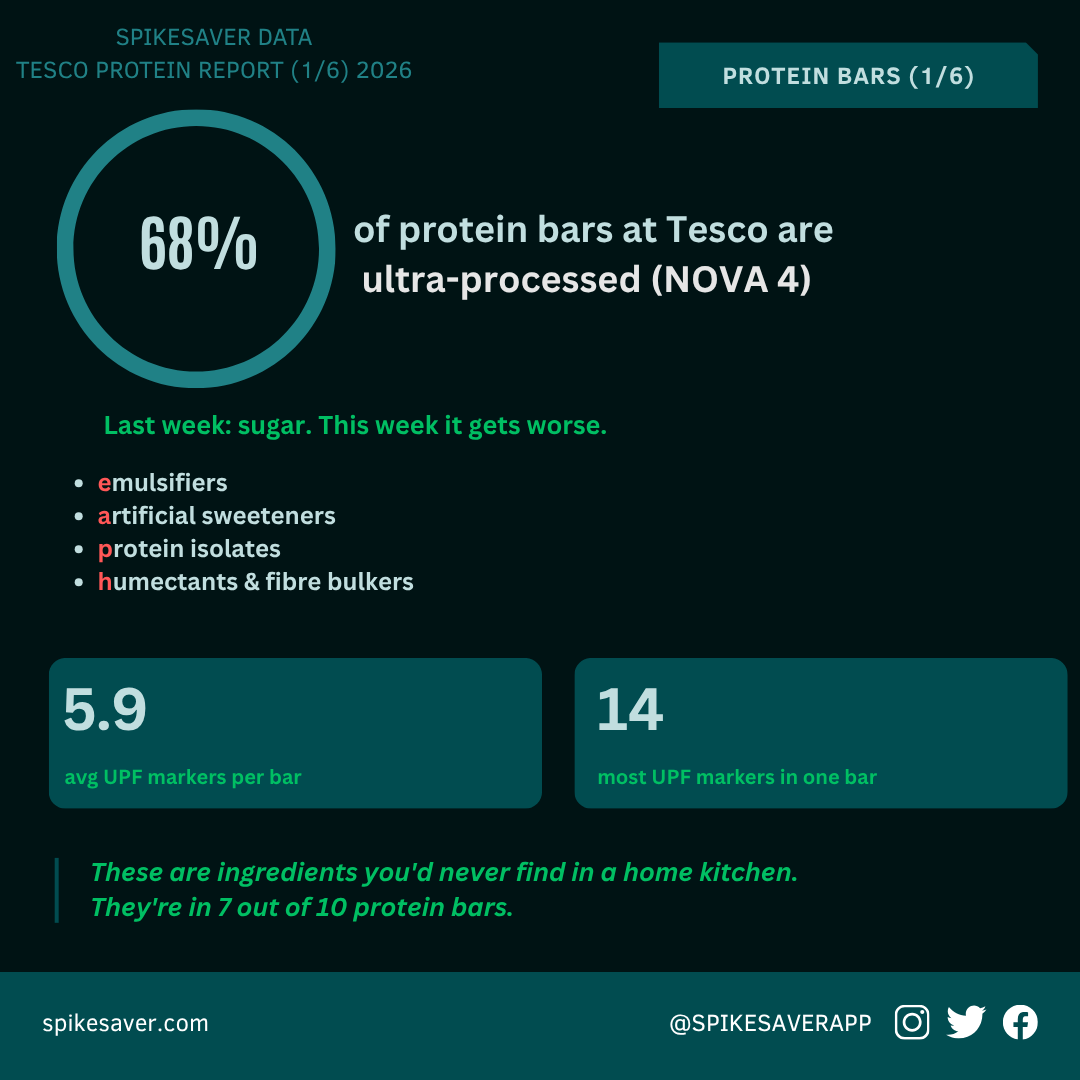
What does ultra-processed mean?
The NOVA classification system, developed by researchers at the University of São Paulo, groups foods into four categories based on the extent and purpose of processing. NOVA 4 — ultra-processed foods — are industrial formulations made mostly or entirely from substances derived from foods, with little or no whole food remaining.
These products typically contain ingredients you would not find in a home kitchen: emulsifiers, humectants, flavour enhancers, and industrial oils. They are designed for convenience, long shelf life, and hyper-palatability — not nutrition.
Growing evidence links ultra-processed food consumption to higher rates of obesity, type 2 diabetes, cardiovascular disease, and certain cancers. In the UK, ultra-processed foods now account for more than half of the average diet.
The 93% problem
65 out of 70 Tesco protein bars are ultra-processed (NOVA 4)
Not a single product passed a clean-ingredient test. Zero out of 70.
93% of the protein bars listed on Tesco.com are ultra-processed. The remaining 5 products are NOVA 3 (processed) — still not unprocessed foods. Not a single bar passed a strict clean-ingredient test across all 18 brands.
The worst offenders average 10+ UPF markers per product. Myprotein Crispy Square Marshmallow contains 12 UPF markers and hides sugar under 6 different names. Kellogg's High Protein bars contain 11 UPF markers despite marketing themselves as a health product.
Even brands perceived as clean — like Grenade and Fulfil — are 100% NOVA 4 across their entire range. Every single Grenade bar is ultra-processed.
Myprotein Crispy Square Marshmallow uses 6 different names for sugar
Sugar, glucose syrup, glucose-fructose syrup, dextrose, fructose, and honey — all in a single 30g product with 12 UPF markers.
Hall of shame
The 10 most processed protein bars at Tesco, ranked by combined UPF marker + sugar alias score:
- Myprotein Crispy Square Marshmallow — 12 UPF markers, 6 sugar aliases, 19g sugar/100g
- Myprotein White Chocolate Cookie Bar — 13 UPF markers, 3 sugar aliases, 13g sugar/100g
- Kellogg's High Protein Almond & Dark Chocolate — 11 UPF markers, 4 sugar aliases, 23g sugar/100g
- Kellogg's High Protein Almond & Salted Caramel — 11 UPF markers, 4 sugar aliases, 24g sugar/100g
- Grenade Carb Killa Dark Chocolate Mint — 14 UPF markers, 0 sugar aliases, 0.7g sugar/100g
The “least bad” options
No protein bar passed a clean-ingredient test, but some brands are measurably better than others. The 5 products classified as NOVA 3 (processed, not ultra-processed) are the closest to clean:
- Eat Natural: 2 of 3 products are NOVA 3 — the shortest ingredient lists in the category
- Nakd: NOVA 3, 7 ingredients, 16g fibre — minimal processing but still not unprocessed
But “least bad” is still not clean. Even the NOVA 3 bars contain processed ingredients, and several have 20g+ sugar per 100g. SpikeSaver analyses both processing AND nutrition — because you need both signals.
Find out which protein bars are actually clean
Includes rankings, ingredient breakdowns, and hidden sugar insights for all 70 products.
What can you do about it?
Awareness is the first step. The protein bar aisle is designed to look healthy — bold “high protein” claims, clean-looking packaging, fitness imagery. But the ingredient list tells a different story for 93% of products.
SpikeSaver was built to solve this problem. It's a Chrome extension that analyses every product on Tesco.com against your health goals — including UPF detection, sugar content, and more — so you can make informed choices without reading every label.
If you want to understand what's really in your protein bars, start with the report above. If you want to make better choices every time you shop, start using SpikeSaver while you shop →
Know someone buying protein bars?