NOVA Classification Report

Are Easter Eggs Ultra-Processed?

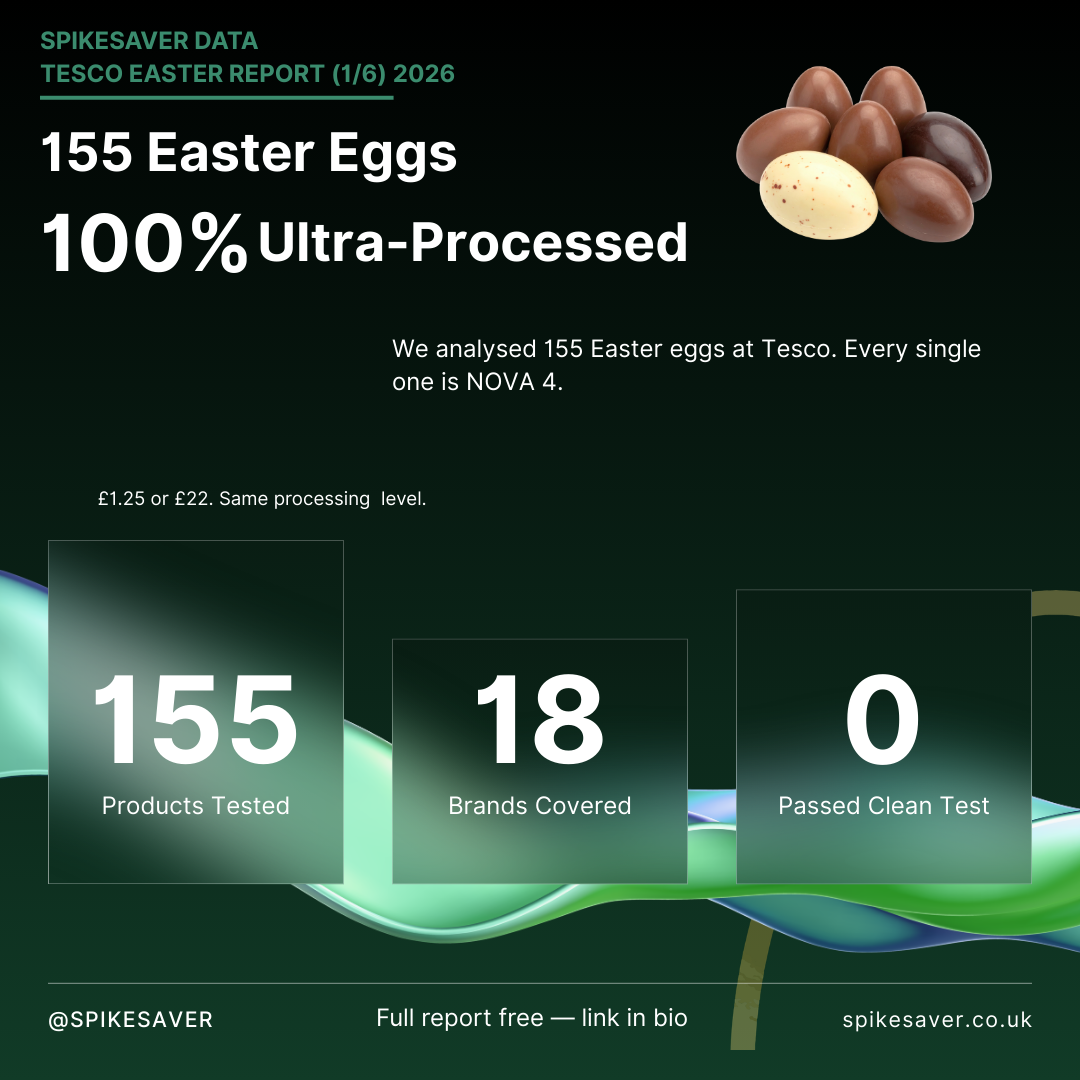
We analysed every Easter egg listed on Tesco.com using the NOVA food classification system. The results: all 155 are ultra-processed.

155
eggs analysed
100%
ultra-processed
14
avg ingredients
0
passed clean test
SpikeSaver Easter Egg Report — 155 products tested, 100% ultra-processed

Get the full Easter Egg report (PDF)

Includes brand rankings, ingredient analysis, and hidden sugar breakdowns for all 155 products.

Based on analysis of 155 real Tesco products. No spam — just reports. Privacy Policy

What does ultra-processed mean?

The NOVA classification system, developed by researchers at the University of São Paulo, groups foods into four categories based on the extent and purpose of processing. NOVA 4 — ultra-processed foods — are industrial formulations made mostly or entirely from substances derived from foods, with little or no whole food remaining.

These products typically contain ingredients you would not find in a home kitchen: emulsifiers, humectants, flavour enhancers, and industrial oils. They are designed for convenience, long shelf life, and hyper-palatability — not nutrition.

Growing evidence links ultra-processed food consumption to higher rates of obesity, type 2 diabetes, cardiovascular disease, and certain cancers. In the UK, ultra-processed foods now account for more than half of the average diet.

Every Easter egg failed

Not a single Easter egg passed the clean ingredient test

All 155 products across 18 brands scored NOVA 4 — the highest processing level.

Of the 155 Easter egg products listed on Tesco.com, every single one was classified as NOVA 4 — ultra-processed. This is not an edge case. It is the structural reality of the category.

The average product contains 14 ingredients. At the extreme end, Cadbury Mini Egg Choc Cakes contains 48 ingredients and 9 distinct UPF markers, including emulsifiers, raising agents, and modified starch.

Even brands perceived as premium or artisanal — such as Thorntons and Lindt — rely on the same ultra-processed formulations. Zero products passed a strict clean-ingredient test.

Thorntons Continental uses 8 different names for sugar

Sugar, glucose syrup, invert sugar syrup, molasses, honey, dextrose, lactose, and maltodextrin — all in a single product. Splitting sugar across multiple names makes it harder to spot on an ingredient list.

Hidden sugar is everywhere

56 of the 155 products hide sugar behind 3 or more different ingredient names. This is not accidental. By splitting sugar across names like glucose syrup, dextrose, and maltodextrin, manufacturers push sugar further down the ingredient list — making it appear less dominant than it really is.

54 products contain seed or industrial oils such as palm oil, sunflower oil, or rapeseed oil. These oils are a hallmark of ultra-processed formulations, used for texture, shelf life, and cost rather than taste or nutrition.

The “least bad” options

While no Easter egg passed a clean-ingredient test, some brands are measurably better than others. NOMO averages the lowest sugar content at 33.2g per 100g, compared to Cadbury at 57.1g. Moo Free and Ombar also tend to use shorter ingredient lists with fewer UPF markers.

But “least bad” is still NOVA 4. Even the cleanest Easter egg on Tesco's shelves is an ultra-processed product. The difference is one of degree, not kind.

The full report includes brand-by-brand rankings, a complete ingredient analysis, and a guide to the most common hidden sugar aliases found across all 155 products.

Find out which Easter eggs are the least bad

Includes rankings, ingredient breakdowns, and hidden sugar insights.

Based on analysis of 155 real Tesco products. No spam — just reports. Privacy Policy

What can you do about it?

Awareness is the first step. The food industry does not make it easy to identify ultra-processed products. Ingredient lists are long, jargon-heavy, and deliberately opaque. Labels like “no artificial colours” or “made with real chocolate” create a halo effect that masks the underlying formulation.

SpikeSaver was built to solve this problem. It's a Chrome extension that analyses every product on Tesco.com against your health goals — including UPF detection, sugar content, and more — so you can make informed choices without reading every label.

If you want to understand what's really in your Easter eggs this year, start with the report above. If you want to make better choices every time you shop, start using SpikeSaver while you shop →

Know someone buying Easter eggs this year?

Post on X

Frequently asked questions

Are all Easter eggs ultra-processed?

Yes. Every one of the 155 Easter egg products we analysed at Tesco is classified as NOVA 4 — ultra-processed. This includes budget and premium brands alike. Not a single product passed a clean ingredient test.

Are there any healthy Easter eggs?

No Easter egg in our dataset qualifies as healthy by strict nutritional standards. However, some brands are measurably better than others. NOMO has the lowest average sugar (33.2g/100g) and Ombar uses shorter ingredient lists. See the least bad options or get the full report for brand-by-brand rankings.

What does NOVA 4 mean?

NOVA is a food classification system developed by researchers at the University of São Paulo. NOVA 4, the ultra-processed category, describes industrial formulations made mostly from substances derived from foods — emulsifiers, flavour enhancers, industrial oils — rather than whole ingredients. Read our full NOVA classification guide or the explainer above.

Why do Easter eggs hide sugar under different names?

By splitting sugar across names like glucose syrup, dextrose, and maltodextrin, manufacturers push each one further down the ingredient list. This makes sugar appear less dominant than it really is. We found 56 products using 3 or more sugar aliases.

How was this research conducted?

We collected ingredient and nutrition data for all 155 Easter egg products listed on Tesco.com across 18 brands. Each product was classified using the NOVA framework and analysed for sugar content, sugar aliases, UPF markers, protein quality, and net carbs. The full report includes complete methodology and data.

Go deeper on ultra-processed food

This report is part of a wider SpikeSaver research project. Explore the guides and tools behind the analysis.

More Easter Egg Reports

More insights from this research

Coming next

Breakfast Cereals: How Ultra-Processed Is Your Morning?

Same methodology. Different aisle. Sign up above to get notified.

SpikeSaver

Try SpikeSaver while you shop on Tesco

See this analysis on every product while you shop.

Spot ultra-processed foods, hidden sugars, and better alternatives instantly.

Try SpikeSaver on Tesco

Free · 155 products analysed