SpikeSaver Blog · Supermarket Secrets

10 Things Tesco Does Online That You Don't See In Store

A personal investigation into the structural, algorithmic and commercial forces that make healthy shopping harder than it should be — and why none of it is an accident.

C
Colin · Founder, SpikeSaver
Diagnosed Type 2 diabetic · 2016
15 min readInvestigativeMarch 2026
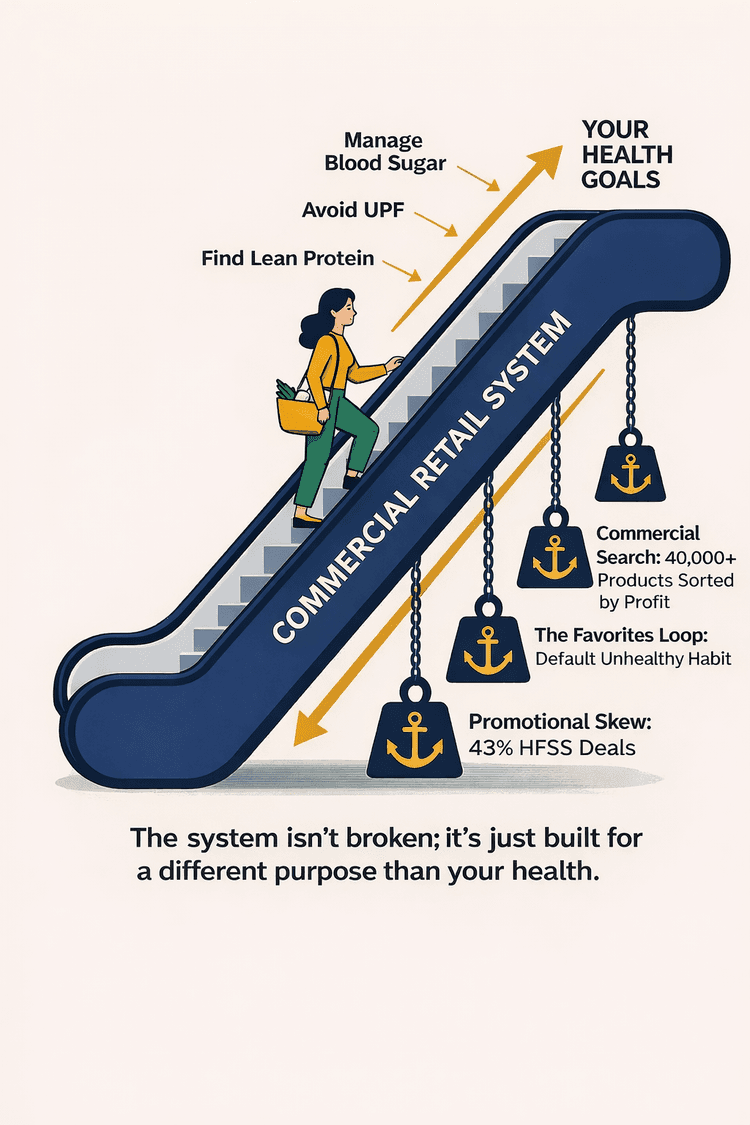
The Commercial Retail System escalator — how online supermarkets work against your health goals
The system isn't broken — it's just built for a different purpose than your health.
In This Article

In 2016 I was diagnosed with Type 2 diabetes.

It changed everything. Suddenly food wasn't just food — it was information. I started reading every label, questioning every ingredient, trying to understand what my body actually needed versus what the packaging was telling me.

I thought online shopping would make this easier. No checkout temptations, no rushing through aisles. Just me, a search bar, and the ability to read every label at my own pace before anything went in the basket.

It didn't work out that way.

Week after week I'd open Tesco.com with good intentions and somehow end up with a shop that didn't reflect them. I couldn't work out why. So I started paying closer attention — not just to the products, but to the website itself. The way it was structured, what it surfaced, what it buried, what information it chose to show me and what it left out.

What I found surprised me — but perhaps it shouldn't have. According to Kantar's 2024 research, 67% of UK consumers are actively trying to eat healthily. Yet 42% cite cost as a barrier, and 27% say confusion about what's healthy stops them from making better choices altogether. Nearly three quarters of UK adults trying to improve how they eat, and the system designed to help them shop is working against them.

I knew shopping healthily online would be like climbing to the top of a staircase, but no one told me the staircase was rigged and was secretly an escalator going in the opposite direction.

Digging into the research, I found 10 things Tesco — and most major UK supermarkets — do online that make healthy shopping harder than it should be. Some are structural. Some are algorithmic. Some are simply the absence of information that should be there by default.

I don't believe any of them are accidents.

You can fill an entire Tesco basket without ever seeing a single ingredient.

The Tricks Haven't Gone Away.
They just moved online — where you can't see them.
In-Store vs Online
In StoreThe tricks you already know
🍫
Chocolate at the checkout
High-impulse HFSS products placed where you're waiting and distracted, right before you pay.
🍞
The smell of fresh bread
Pumped through ventilation to trigger hunger and increase basket size.
🥛
Essentials at the back
Milk, eggs, bread — basics you came for — placed as far from the entrance as possible.
🏷️
Gondola ends sold to brands
The end of every aisle is premium commercial real estate — paid for by whoever wants your attention most.
OnlineThe tricks you don't see
🛒
Sponsored products in search results
The top results aren't the most relevant — they're the ones brands paid to place there.
The Favourites loop
Your previous unhealthy purchases auto-populate your basket every week with zero nudge to change.
📊
Nutrition buried 3 screens deep
You can add a product to your basket without ever seeing a single ingredient or nutrition figure.
💰
"Usually Bought Next" — paid placement
The digital gondola end. Commercially driven, not curated for your health. 43% of featured products are HFSS.
In-store tricks are visible. Online tricks are invisible. Both are deliberate.
1

The Search Algorithm Is Not Your Friend

The first thing most people do on Tesco.com is search. It feels like a neutral act — you type what you want, the site shows you what it has. But Tesco's search algorithm doesn't work like that. With roughly 40,000 products on the site, what appears at the top of your results is determined by popularity, commercial placement, and what suppliers have paid to feature — not by what's nutritionally relevant to you.

I discovered this early on in my own investigation. As someone newly diagnosed with Type 2 diabetes, one of my first searches was for diabetic biscuits. The results looked promising. Products marketed directly at people like me, right at the top of the page. What I found when I actually read the labels told a different story — high in carbs, which directly raises blood sugar, but low in sugar, which made them sound appropriate on the surface. And between you and me, the sugar alcohols they used as a substitute came with their own unpleasant side effects that no label warned me about either. The search matched the keyword. It had no mechanism to care whether the products were actually suitable for my condition.

That was just the beginning. Search “low carb” and the results are dominated by low fat — a completely different nutritional category that means almost nothing for blood sugar management. Search “keto” and you get practically nothing relevant. Search “non ultra processed” and the site looks back at you blankly — a term that represents one of the fastest growing health movements in the UK, and Tesco's search engine doesn't recognise it at all.

📊
A 2020 study of leading online grocery sites found that while many offered basic nutrition-related filters, none allowed shoppers to sort products by a nutrition attribute like sodium or sugar content — and mandatory label information was often incomplete or hard to access. [Grummon et al., Journal of Nutrition Education and Behavior, 2020]

When Tesco did introduce dietary filters through their SpoonGuru AI partnership — which was genuinely a step forward — their own help page quietly warned shoppers: “do not rely solely on this information and always check product labels.” The system they built to help you find healthy food comes with a disclaimer telling you not to trust it fully.

The algorithm isn't broken. It's just built for something other than your health goals. Every major UK supermarket runs its search the same way — a commercial tool first, a discovery tool second. Healthy options exist on every platform. But finding them requires already knowing exactly what you're looking for, which is precisely the knowledge most people are trying to build in the first place.

2

The Promotional Environment Still Favours Processed Food

Walk into any supermarket and you'll notice the same thing — the deals, the multi-buys, the end-of-aisle displays are rarely stacked with broccoli and lentils. The most heavily promoted products have always skewed towards high fat, high sugar, and high salt. Online, for a long time, it was exactly the same.

To be fair to Tesco, they have made moves. They voluntarily removed HFSS — high fat, salt and sugar — volume promotions from their website before the government even required them to. That's not nothing. And in 2023 their own data showed customers were buying more healthy products as a result.

But removing the worst offenders isn't the same as fixing the environment.

43%
of all online food promotions are for products high in fat, salt, or sugar — with UK supermarkets running over 4,000 unhealthy food promotions every week across their platforms. [Obesity Health Alliance]

A peer-reviewed systematic review published in 2022 concluded that “pricing and promotional strategies were commonly applied to unhealthy products,” while healthier alternatives received significantly less promotional support.

The practical impact is visible in the details. Look at the yoghurt aisle on Tesco.com and you'll often find the standard, higher-sugar versions carrying a Clubcard Price discount — while the high-protein, low-sugar equivalent sits at full price. The healthier choice costs more and gets no promotional nudge. The less healthy choice costs less and gets a green price tag.

The wider promotional space — the featured product strips, homepage banners, sponsored placements, and “Customers also bought” suggestions — remains commercially driven. These slots are bought and paid for by brands with the biggest marketing budgets. And the brands with the biggest marketing budgets are rarely the ones selling plain oats and tinned fish.

The result is a promotional environment that has improved at the edges while remaining fundamentally commercial at its core. If a product is prominently featured on Tesco.com, the most likely reason is that someone paid for it to be there — not that it's good for you.

3

The Digital End-of-Aisle

In every physical supermarket, the most valuable real estate isn't the shelves — it's the end of them. The gondola end, as it's known in retail, is the space brands pay a significant premium to occupy. It's where the multi-buys live, where new products launch, where seasonal promotions dominate. It is, by design, the most commercially exploited space in the building.

Online, the equivalent doesn't look like a shelf end. It looks like a homepage banner. A “Featured Products” strip. A “Customers also bought” suggestion at the bottom of a product page. A “You might like” carousel appearing mid-shop. These aren't editorial choices made by someone thinking about your health — they are paid placements, algorithmically served, and commercially optimised in exactly the same way as the biscuit display at the end of aisle seven.

The difference is that in a physical store, you can see the gondola end for what it is. You walk past it. You make a choice. Online, the commercial architecture is invisible. There is no visual cue that a featured product strip is a paid placement rather than a genuine recommendation. There is no indication that the items appearing in your “Customers also bought” section were surfaced by an algorithm optimising for revenue rather than nutrition.

⚠️
A 2022 systematic review found that online grocery sites have features that could “unintentionally push consumers toward less healthy options, simply because those tactics drive sales.” The word unintentionally is doing a lot of work in that sentence. [Maganja et al., 2022]

Two examples I found on Tesco.com illustrate this perfectly.

⚠️ Real Example 1 — Salmon with Baby Potatoes

You add: Tesco 2 Boneless Salmon Fillets 260G — an excellent diabetic choice. Zero carbs, high protein, rich in omega-3.

Tesco "Usually Bought Next" suggests…

Tesco Finest Baby Potatoes 750GTesco Broccoli 375G ✓Tesco Smoked Salmon ✓Tesco Asparagus Tips ✓
Baby Potatoes appear first — one of the highest glycaemic index foods available. The algorithm reflects what the general population buys with salmon. Your health condition is invisible to it.
⚠️ Real Example 2 — Steak with a High-Carb Sauce Deal

You add: Tesco Beef Rump Steak — a solid choice for blood sugar management. High protein, zero carbs.

Tesco "Usually Bought Next" suggests…

Schwartz Peppercorn Sauce Mix — Clubcard DealCheddar Cheese Sauce Mix — Clubcard DealBeer Battered Onion Rings
❌ Schwartz Peppercorn Sauce: wheat flour as first ingredient, 58.2g of carbs per 100g — and it comes with a Clubcard promotion (Any 4 for £2.50). The algorithm isn't just suggesting the wrong product. It's financially incentivising it.

Every default — what appears at the top of a search, what gets recommended alongside your chicken breast, what fills the homepage when you log in — has been shaped by commercial decisions made long before you opened your laptop. You are navigating a space that has been carefully designed. Just not for you. Three barriers in, and the escalator is already pulling hard.

This is exactly the kind of issue SpikeSaver flags automatically. It identifies commercially placed products, checks ingredients against your health goals, and flags misleading pairings — all while you browse Tesco.com as normal.
See How It Works →
4

The Label You Can't Fully See

If the search algorithm is the first line of defence between you and a healthy shop, nutrition labelling is the second. And online, it's almost as unreliable.

In a physical supermarket, the nutrition label is right there in your hand. You can turn the product over, read the ingredients, check the sugar content before anything goes in the trolley. The information is unavoidable. Online, that same information is anything but. A 2015 academic study found that zero nutrition labels appear on search results pages — the pages where most people make their decisions and add items directly to their basket.

📊
Studies show only 4.2% of online grocery shoppers actually viewed nutrition panels during a shopping session. Not 42%. Not 14%. Four point two percent. [NCBI/NIH, 2020]

But the more troubling problem isn't accessibility — it's accuracy. Or rather, the appearance of accuracy. During my own research I searched “sugar free chocolate” on Tesco.com. Two products appeared under the Free From category — exactly the kind of result a diabetic shopper would trust.

⚠️ Real Example — Found on Tesco.com During Research

Search: "sugar free chocolate" → appeared under Free From

Non-dairy alternative to milk chocolate

Dairy FreeNut FreeGluten FreeEgg FreeSuitable for Vegans
❌ First ingredient listed: Sugar. Nutrition panel: 33g of sugar per 100g — a third of the product by weight is the ingredient you searched to avoid.

Every claim on this product's label is technically accurate. It is genuinely free from dairy, gluten, and nuts. But it appeared in a sugar free search, under a Free From category, with no flag, no warning, and no mechanism to tell a diabetic shopper that they were looking at a product that would spike their blood sugar significantly.

A 2021 comparison study found that online products were significantly less likely to provide front-of-pack nutrition labelling than their physical in-store equivalents. Researchers identified eight different label design combinations across Tesco and Sainsbury's platforms. Only 41% of products displayed traffic light coloured labels. The system isn't designed to make you look at the information that matters most.

To illustrate just how buried this information is, here's the actual journey I took on a single Tesco product page — the Schwartz Peppercorn Sauce suggested alongside a steak:

📱 The 3-Screen Journey to Find Ingredients on Tesco.com
1
Screen 1 — Product image, price, Clubcard deal, Add to basket. You can buy this product from this screen without seeing a single ingredient. The “Add” button is right there.
2
Screen 2 — “Usually Bought Next” and “Related Special Offers.” More processed sauces, all with Clubcard deals. Still no ingredients. Still no nutrition information. Pure commercial content.
3
Screen 3 — Finally the ingredients. But first: Tesco makes you read the product Highlights — “No Hydrogenated Fat,” “No Added Preservatives,” “No Artificial Colours.” Marketing claims designed to create a health halo before you reach the actual ingredient list, which starts with wheat flour and shows 58.2g of carbs per 100g.
5

The Fresh Produce Penalty

For someone managing Type 2 diabetes, fresh produce isn't optional. Vegetables, lean proteins, low-carb alternatives — these aren't lifestyle choices, they're medical ones. So when I started shopping online, getting fresh food right wasn't a preference. It was the whole point.

What I hadn't anticipated was how much of the online grocery experience works against exactly that.

The fundamental problem is trust. In a physical supermarket you choose your own produce. You pick up the avocado, judge its ripeness, check the dates on the chicken. Online, you surrender all of that. You're trusting a picker you've never met, working to a speed target you're not aware of.

71%
of non-online shoppers cite the inability to physically inspect products as their primary barrier to buying fresh food online. And 44% of people who already shop online regularly still express concerns. This doesn't go away with familiarity. [YouGov]

When shoppers don't trust the fresh aisle online, they don't switch to nothing. They switch to whatever feels safe. And what feels safe online is what comes in a packet, has a long shelf life, and looks the same every time. In other words — processed food.

When fresh produce does make it into an order, the risks don't disappear. A 2023 Which? investigation published in The Guardian found short shelf lives were a consistent and documented problem, with one extreme case of items arriving eleven days past their use-by date.

But the substitution problem is where it gets most serious for shoppers with specific dietary needs. When an ordered item is out of stock, supermarkets substitute automatically. The algorithms and pickers making those decisions have no awareness of why you ordered what you ordered.

🔄
I ordered cauliflower rice.For a diabetic, cauliflower rice isn't a trendy swap — it's a tool for managing carbohydrate intake. Normal rice causes a significant blood sugar spike. What arrived in my delivery was normal rice. This exact scenario is documented in the Diabetes UK community forum — it's not an isolated incident. [Diabetes UK Forum]

Resolver research found that 44% of online grocery orders contain at least one substitution. At that frequency, shoppers with specific dietary needs aren't dealing with an occasional inconvenience — they're managing a persistent reliability problem that undermines the entire value of planning a healthy shop.
6

The Favourites Loop

Of all the barriers in this investigation, this one is the most subtle. It doesn't look like a problem. It looks like a feature.

Tesco's Favourites and Previous Orders functions are genuinely useful. They save time. They reduce the cognitive load of a weekly shop. For busy people — which is most people — the ability to rebuild last week's basket in a few clicks is a real convenience. I used it myself.

But here's what I noticed over time. My shop wasn't really changing. Week after week, the same products appeared. The same brands, the same choices, the same patterns I'd built before I was diagnosed — before I understood what I should actually be eating. The Favourites list had locked in habits I was actively trying to break, and the path of least resistance was to keep clicking them back into the basket.

🔬
A 2025 qualitative study of French online grocery shoppers found that people tended to buy the same items repeatedly, relied heavily on recommendation lists, and often ended up purchasing fewer fresh products and more processed alternatives — suggesting that current recommendation setups reinforce existing habits rather than encourage dietary diversity. [Ducrot et al., Public Health Nutrition, 2025]

Research documented that products within Favourites lists are buried in horizontally scrolling carousels where “most of the items are off the screen so can't be easily seen.” Essential healthy staples get lost in lists dominated by whatever was ordered most frequently. Shoppers report that items they genuinely want get “regularly forgotten about” because they're hidden in a list that prioritises familiarity over visibility.

Tesco's own Better Baskets campaign successfully nudged millions of shoppers toward healthier purchases — demonstrating that when the platform applies its influence in a health-positive direction, it works. The same algorithmic power that locks people into repeat unhealthy purchasing loops could surface healthier alternatives, flag when a favourite product has been replaced by a better option, or simply ask once a month whether your dietary needs have changed. It doesn't. Because that's not what it was built for.

💰
In April 2025, Sainsbury's began inserting sponsored products into shoppers' Favourites lists despite those products never having been purchased — described by one documented consumer as “a new level of devious, under-handed selling tactics.” The feature that feels most personal had been quietly monetised.

Six barriers down. The escalator isn't just pulling against you — it's accelerating.

Online grocery shopping is the only place you can buy food without ever seeing what's in it.

SpikeSaver breaks the favourites loop.It scores every product in your basket against your health goals in real time — so you can see at a glance what's working for you and what isn't, before you check out.
Get Early Access to SpikeSaver →
7

The Regulatory Gap Nobody Fixed

By this point in my investigation, a question kept surfacing. If these problems are this well documented — if researchers, consumer groups, and shoppers themselves have been identifying them for years — why hasn't anyone stepped in to fix them?

The answer, it turns out, is that someone was supposed to. They just didn't.

The UK Government committed to restricting the promotion of high fat, salt and sugar products online. The legislation was designed to do for the digital grocery environment what earlier regulations had begun doing in physical stores. It was a meaningful intervention. And it was delayed.

When the delay came, Tesco made a notable decision — they kept their voluntary HFSS promotion restrictions in place anyway. That matters, and it's worth acknowledging. But one supermarket acting voluntarily is not the same as a regulated industry acting consistently.

⚖️
A 2024 analysis of major online food retailers found that required nutrition panels were present, conspicuous and legible on well under half of product listings — while voluntary front-of-pack and marketing-style labels appeared far more consistently. Promotional claims were easier to see than mandatory nutrition information. [Taillie et al., Public Health Nutrition, 2024]

There are no mandated rules for how healthy products should appear in search results. No requirement that a “low sugar” search returns products that are genuinely low in sugar. No obligation for supermarkets to disclose when a featured slot has been commercially purchased. No standard for how nutritional information must be presented online.

Which? reported Tesco to the Competition and Markets Authority in 2023 for omitting unit prices on Clubcard promotional items. The CMA's own review found that existing pricing law “leaves too much scope for interpretation.” The rules meant to protect shoppers were vague enough that a major supermarket could operate in the grey space without penalty.

The system wasn't designed to help you eat well. And nobody with the power to change that has done so yet.

8

Hidden Ingredients and the UPF Problem

Everything examined so far exists at the level of the platform. This barrier goes deeper — into the products themselves.

Ultra-processed food is now one of the fastest growing concerns in nutrition science and public health. The NOVA classification system — which categorises food by the degree of industrial processing rather than just its nutrient content — has shifted how researchers, doctors and health-conscious consumers think about what they're eating. A product can be low in calories, low in saturated fat, and still be NOVA 4 — the most heavily processed classification — because of the emulsifiers, flavourings, stabilisers and processing aids used in its manufacture.

On Tesco.com, there is no NOVA score. There is no ultra-processed food classification. There is no flag, filter, or indicator of any kind that tells you whether a product is minimally processed or industrially manufactured.

🍬
Sugar alone hides under more than 50 different namesthat manufacturers use across their products — glucose syrup, dextrose, maltodextrin, fruit juice concentrate, dried glucose syrup, invert sugar, treacle. Each one is sugar. None of them say sugar. A label-conscious shopper can miss every single one if they don't know what they're looking for.
50+ Names Manufacturers Use for Sugar
None of them say “Sugar”
Glucose Syrup
Dextrose
Maltodextrin
Fruit Juice Concentrate
Invert Sugar
Treacle
Fructose
Sucrose
Lactose
Dried Glucose Syrup
Molasses
Agave Nectar
Rice Syrup
Barley Malt Extract
Caramel
Honey
Maple Syrup
Corn Syrup
Date Syrup
Coconut Sugar
Cane Juice
Demerara Sugar
Muscovado
+ 30 more
SpikeSaver flags all of them automatically — so you don't need to memorise a single one. Every product you view on Tesco.com gets scanned against the full list in real time.

Even shoppers who are actively trying — reading every label, checking every ingredient — are working with incomplete information in a system that provides no tools to fill the gaps. The information is there if you look hard enough. The system just isn't designed to help you find it.

9

Marketing Claims vs. Reality

“High protein.” “Natural.” “Wholegrain.” “No added sugar.” “Free From.”

Front-of-pack marketing claims are the first thing you see on a product page. They are designed to be. They are also, as we saw with the sugar free chocolate search earlier, under no obligation to reflect the full nutritional reality of what's inside the packet.

This creates a shopping environment where the most visible information is the least regulated, and the most regulated information is the least visible. A product carrying a “wholegrain” claim on its thumbnail can be NOVA 4. A product in the Free From section can list sugar as its first ingredient. A product marketed as “natural” can contain a suite of emulsifiers, flavourings and stabilisers that place it firmly in the ultra-processed category.

⚠️ Real Example — Nature Valley Protein Bar on Tesco.com

Browsing: Nature Valley Protein Peanut & Chocolate 8x40g — marketed as a health-conscious, post-workout snack.

Front-of-pack claims:

High Protein (10g)Gluten FreeHigh in FibreNo Artificial FlavoursNo Colours or Preservatives
❌ The ingredient list contains five different forms of sugar — glucose syrup, sugar, maltodextrin, fructose, and lactose — totalling 17.1g of sugar per 100g. It also contains isolated soy protein, humectant (glycerol), and emulsifiers — making it NOVA 4 ultra-processed. The protein claim is valid. Everything it doesn't tell you is the problem.
⚠️
Five names for sugar in one “High Protein” bar — and every single one of them is invisible unless you scroll past the marketing claims, past the commercial suggestions, and read the actual ingredient list. This is exactly the gap between what the front of a product says and what the back of it reveals.

There is no system on Tesco.com that reconciles the marketing claim on the front of a product with the nutritional reality inside it. That reconciliation is left entirely to the shopper — armed with incomplete label information, insufficient time, and a search algorithm that filed the product there in the first place.

10

No Filter for Your Health Goal

Tesco has approximately 40,000 products. You have one specific health goal — or perhaps several that interact with each other. Managing blood sugar. Reducing ultra-processed food. Increasing protein. Avoiding certain allergens. Eating for gut health.

There is no way to tell Tesco.com what you are trying to achieve.

0
The number of health conditions you can tell Tesco.com about. Diabetic, coeliac, managing cholesterol, post-cardiac — the platform treats every shopper identically across 40,000 products.

There is no health goal input. No condition-based filtering. No mechanism that says — this shopper is managing Type 2 diabetes, so flag the high-carb products, surface the low-GI alternatives, and don't substitute cauliflower rice with normal rice. The platform has no interest in your health context.

The filters that do exist — low sugar, high protein, gluten free — are static categories applied to products, not dynamic tools applied to your situation. Low sugar for a diabetic means something different than low sugar for someone cutting calories. High protein for a post-surgery patient means something different than for a gym-goer. The same filter, applied without personal context, gives everyone the same answer regardless of whether that answer is right for them. With 40,000 products and no way to tell the platform what you actually need, finding the right product for your health goals is less like shopping and more like finding a needle in a haystack — except nobody told you which field the haystack was in.

😕
Kantar's 2024 research found that 27% of British consumers say confusion about what's healthy actually stops them buying wellness-focused products. That confusion isn't a knowledge problem — it's an infrastructure problem. A platform serving 40,000 products has built no mechanism to help you navigate them against your own health reality.

Ten barriers. Ten weights on the escalator. And every one of them was there before you opened your laptop.

Why I Built SpikeSaver

After Years of Waiting for the System to Change, I Decided to Build the Solution Myself

I was diagnosed in 2016. For years after that I did what most people in my situation do — I adapted. I read labels. I researched. I built up a mental list of safe foods I knew worked for my condition and bought them, week after week, from a platform that gave me no help doing so.

The frustrations accumulated slowly — in three stages:

  • 1Memory. Trying to hold in my head every food I could eat, every ingredient to watch for, every product I'd approved — it was exhausting. The cognitive load of shopping healthily with Type 2 diabetes is significant, and the online grocery environment adds nothing to reduce it.
  • 2Time. Reading every label, on every product, on every shop. Clicking through to individual product pages. Scrolling to find nutrition information. Cross-referencing ingredients against a mental checklist of 50 sugar aliases. A weekly shop was taking far longer than it should, and I was still missing things.
  • 3Food joy. I had stopped discovering new food. I was eating the same safe things I had found and approved, over and over, because the process of checking anything new was too time-consuming and unreliable. I wasn't eating well. I was eating safely. Over time, those two things are not the same.

I thought about writing a book — a guide to reading food labels for people managing health conditions. But a book sits on a shelf. It doesn't help you at the moment you're deciding whether to put something in your basket at eleven o'clock on a Tuesday night. What was needed wasn't more information in a different format. What was needed was the right information, at the right moment, in the right place.

In 2025 I started building SpikeSaver — a Chrome extension that sits directly on top of Tesco.com and does the work the platform won't. It reads the ingredients list you'd have to scroll to find. It flags the 50+ names manufacturers use for sugar. It identifies ultra-processed markers and NOVA classification. It checks every product against your specific health goals — not a generic framework, but your goals, your condition, your priorities. Automatically. In real time. Without you having to remember anything.

The supermarket escalator is still going down. SpikeSaver just helps you climb faster.

Get Early Access to SpikeSaver →
Chrome extension · No credit card required

So What Do You Do With This?

The ten barriers in this post aren't going anywhere quickly. Tesco's search algorithm will continue to surface products by commercial relevance rather than nutritional merit. The promotional environment will remain shaped by marketing budgets rather than health outcomes. The regulatory framework that should be closing these gaps is still catching up.

None of that is your fault. And none of it reflects a lack of effort on your part. What it reflects is a system that was built for a different purpose than the one you're trying to use it for. You're trying to eat well, manage a health condition, or simply make better choices for yourself and your family. The platform you're using to do that was built to sell 40,000 products as efficiently as possible. Those two goals are not the same.

And here's perhaps the most telling sign of all. The online frustration with healthy shopping has largely gone quiet. Not because the problem has been solved — but because people have accepted it as just how it is. Resignation isn't the same as satisfaction. It's what happens when a problem persists long enough that people stop expecting it to change. That's exactly the kind of accepted friction that a well-timed solution can cut straight through.

You might be wondering whether existing food scanning apps could help with this. Apps like Yuka, Ivy, Nutracheck, and MyFitnessPal are genuinely useful tools — but they're built for a different moment. They work when you're standing in a physical store, phone in hand, scanning a barcode on a shelf. None of them work inside an online supermarket. They can't read Tesco.com. They can't flag products as you browse, check ingredients against your health goals, or intercept a misleading search result before it goes in your basket. The gap they leave is exactly the one SpikeSaver was built to fill.

Understanding why healthy shopping is hard online doesn't make it easier on its own. But it does change what you look for — and what you stop blaming yourself for.

If this post resonated with you — if you've felt the frustration of trying to shop healthily online and wondering why it's so hard — share it with someone who needs to read it. The more people understand how the system works, the harder it becomes for the system to keep working that way.

Share this🐦 Twitter / X💼 LinkedIn📱 WhatsApp

Sources & References

  1. Kantar. Appetite for Growth: New Health Paradigm. 2024. kantar.com
  2. Maganja et al. Evidence Gaps in Assessments of the Healthiness of Online Supermarkets. Systematic Review, 2022. pubmed.ncbi.nlm.nih.gov
  3. Grummon et al. How Online Grocery Stores Support Consumer Nutrition Information Needs. Journal of Nutrition Education and Behavior, 2020. pubmed.ncbi.nlm.nih.gov
  4. Tesco / SpoonGuru. Tesco Little Helps Case Study. spoon.guru
  5. NCBI / NIH. Nutrition Facts Panel Viewing Rates Among Online Grocery Shoppers. 2020. ncbi.nlm.nih.gov
  6. Obesity Health Alliance. The Problem of Unhealthy Multi-Buy Promotions Online. 2020. obesityhealthalliance.org.uk
  7. YouGov. Lack of Frequent Orders Holding Back Online Grocery Market. yougov.co.uk
  8. The Guardian / Which?. Investigation Reveals UK's Freshest and Least Fresh Online Groceries. 2023. theguardian.com
  9. Diabetes UK Forum. Annoyed by Grocery Shopping. forum.diabetes.org.uk
  10. Resolver. Online Grocery Substitution Frequency Survey. resolver.co.uk
  11. Ducrot et al. Understanding the influence of online grocery shopping on consumers' choice of products and dietary balance: a qualitative study in France. Public Health Nutrition, 2025. pubmed.ncbi.nlm.nih.gov
  12. Taillie et al. Disclosure of mandatory and voluntary nutrition labelling information across major online food retailers in the USA. Public Health Nutrition, 2024. doi.org
  13. Which? / CMA. Tesco Clubcard Unit Pricing Complaint. 2023. which.co.uk
  14. UK Academic Study. Online Nutrition Labelling Across UK Supermarkets. 2015 / 2021. pmc.ncbi.nlm.nih.gov
Back to all posts